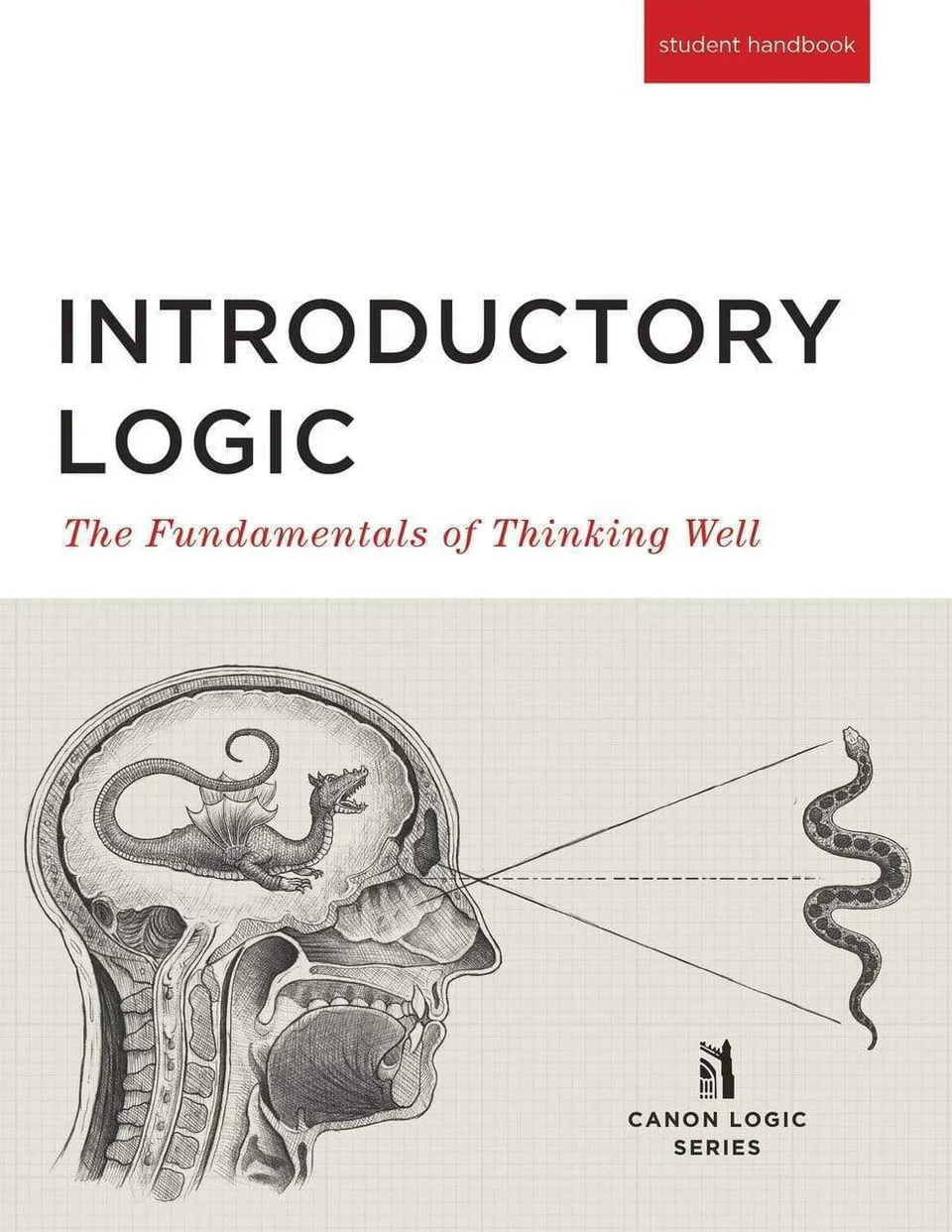
Introductory Logic Student Handbook
It's the tool for learning how to use other tools.
It's the bones that give a clenched fist its structure (and knuckles).
Introductory Logic is perfect for Grade 7+ students, teachers, and parents who've never tackled syllogisms or fallacies before. It provides a semester or year's worth of logic to help you detect and deflect flawed or deceitful arguments and to think, debate, and argue well.
Lesson Scope of Introductory Logic
- Introductory Logic helps you
- Control the debate by defining your terms, because “He who defines the terms wins the debate.” (Unit 1—Terms and Definitions)
- Think logically when you can write true and false statements. (Unit 2—Statements and Their Relationships)
- Disprove invalid arguments when you know the rules of a valid argument. (Unit 3—Syllogisms and Validity)
- Interpret and expose an argument’s logic hiding in normal English. (Unit 4—Arguments in Normal English)
- Detect when someone else is arguing badly with distraction, ambiguity, or form. (Unit 5—Informal Fallacies)
Contents of Introductory Logic, Student Edition
-
- 40 lessons covering formal and informal logic
- sidebars with definitions, key points, cautions, further study, activities for thinking deeper, and historical information
- perforated pages with practice exercises
It's the tool for learning how to use other tools.
It's the bones that give a clenched fist its structure (and knuckles).
Introductory Logic is perfect for Grade 7+ students, teachers, and parents who've never tackled syllogisms or fallacies before. It provides a semester or year's worth of logic to help you detect and deflect flawed or deceitful arguments and to think, debate, and argue well.
Lesson Scope of Introductory Logic
- Introductory Logic helps you
- Control the debate by defining your terms, because “He who defines the terms wins the debate.” (Unit 1—Terms and Definitions)
- Think logically when you can write true and false statements. (Unit 2—Statements and Their Relationships)
- Disprove invalid arguments when you know the rules of a valid argument. (Unit 3—Syllogisms and Validity)
- Interpret and expose an argument’s logic hiding in normal English. (Unit 4—Arguments in Normal English)
- Detect when someone else is arguing badly with distraction, ambiguity, or form. (Unit 5—Informal Fallacies)
Contents of Introductory Logic, Student Edition
-
- 40 lessons covering formal and informal logic
- sidebars with definitions, key points, cautions, further study, activities for thinking deeper, and historical information
- perforated pages with practice exercises
Original: $48.57
-65%$48.57
$17.00Description
It's the tool for learning how to use other tools.
It's the bones that give a clenched fist its structure (and knuckles).
Introductory Logic is perfect for Grade 7+ students, teachers, and parents who've never tackled syllogisms or fallacies before. It provides a semester or year's worth of logic to help you detect and deflect flawed or deceitful arguments and to think, debate, and argue well.
Lesson Scope of Introductory Logic
- Introductory Logic helps you
- Control the debate by defining your terms, because “He who defines the terms wins the debate.” (Unit 1—Terms and Definitions)
- Think logically when you can write true and false statements. (Unit 2—Statements and Their Relationships)
- Disprove invalid arguments when you know the rules of a valid argument. (Unit 3—Syllogisms and Validity)
- Interpret and expose an argument’s logic hiding in normal English. (Unit 4—Arguments in Normal English)
- Detect when someone else is arguing badly with distraction, ambiguity, or form. (Unit 5—Informal Fallacies)
Contents of Introductory Logic, Student Edition
-
- 40 lessons covering formal and informal logic
- sidebars with definitions, key points, cautions, further study, activities for thinking deeper, and historical information
- perforated pages with practice exercises